Exploring Flower Line Art Floral Design for Creative Projects
The creative process often begins with the right visual asset, a foundation that balances aesthetic appeal with practical utility. For designers, crafters, and small business owners, sourcing high-quality, versatile artwork is a critical step. Among the many styles available, Flower Line Art Floral Design represents a specific and popular category. This design approach focuses on the elegant simplicity of continuous, unbroken lines to create floral motifs, from single blossoms to intricate bouquets.
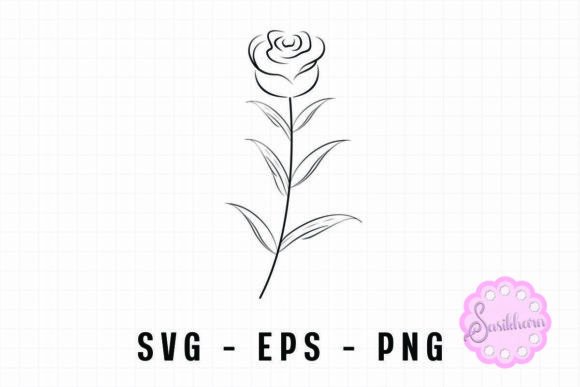
What distinguishes Flower Line Art Floral Design from other floral graphics is its emphasis on contour and form. Unlike shaded illustrations or photorealistic images, it uses clean, deliberate strokes to outline shapes, resulting in a graphic that is both modern and timeless. This minimalist approach prioritizes clarity and scalability, making the design inherently adaptable. The absence of fills and complex textures means the artwork can be easily integrated into various color schemes and backgrounds without losing its essential character.
Evaluating the Format and File Suite
When considering a digital asset like this, the included file formats are a primary factor in its utility. A typical offering, as mentioned, includes an SVG, a PNG with a transparent background at 300 dpi, and an EPS file. Each format serves a distinct purpose, and understanding their strengths is key to evaluating the resource’s value for your specific work.
The SVG file is crucial for scalability. As a vector format, it defines the image using mathematical paths rather than pixels. This means you can resize the Flower Line Art Floral Design from a tiny sticker to a large banner without any loss of quality or introduction of blurriness. It is the preferred format for cutting machines, laser engravers, and any design software where precise manipulation of shapes is needed, such as Adobe Illustrator or Inkscape.
The high-resolution PNG file serves a different need. Its transparent background makes it ideal for quick placements in digital layouts, mock-ups, or even direct use in projects where a raster image is acceptable, such as certain web graphics or simple print-on-demand setups. The 300 dpi specification ensures it is suitable for high-quality physical prints at moderate sizes. The EPS file, another vector format, offers broad compatibility with professional printing systems and older design software, acting as a reliable backup to the SVG.
A comprehensive suite like this compares favorably to resources that offer only a single file type. It provides flexibility, allowing you to choose the right tool for the task without needing to convert or reformat the artwork yourself, which can sometimes compromise quality.
Identifying the Best Fit for Your Project
The decision to use Flower Line Art Floral Design hinges on the nature of your project and your desired outcome. Its strengths are most apparent in certain applications, while its limitations might suggest another style is better suited for different goals.
For projects like custom cups, t-shirts, tumblers, and stickers, the clean lines of this design are a significant advantage. The artwork translates well onto fabrics and curved surfaces, as the crisp edges remain distinct even when printed or etched. On a t-shirt, for instance, a floral line art design can provide a sophisticated, non-gendered aesthetic that appeals to a wide audience. For greeting cards, the style offers a versatile base that can be colored, embossed, or layered with other elements by the designer.
Consider, however, the tradeoff. The minimalist nature of Flower Line Art Floral Design means it lacks depth, texture, and color information. If your project requires a lush, realistic, or painterly feel—such as for a detailed botanical guide or a vintage-inspired poster—this style may feel too stark. In those cases, a watercolor floral graphic or a detailed illustration with shading might be a more appropriate alternative. The line art serves as an excellent foundation or accent, but not as a replacement for styles that demand visual complexity.
Comparing Workflow Integration and Ease of Use
From a practical workflow perspective, the “instant download” and “digital file” aspect addresses a common need for speed and immediacy. Compared to waiting for physical samples or commissioning custom artwork, a ready-to-use file accelerates the prototyping phase. You can quickly test the Flower Line Art Floral Design on a product mock-up to gauge its appeal.
However, ease of use also depends on your technical comfort. Vector files (SVG/EPS) require software that can handle them. If your primary tool is a simple image editor that only works with PNGs or JPGs, the vector files might initially seem less accessible. Yet, even in that scenario, the provided high-res PNG is a fully functional asset. The inclusion of both formats effectively caters to different skill levels and software ecosystems, making the resource helpful for a hobbyist using a basic app and a professional working in an advanced vector suite.
When Alternatives Might Be Worth Exploring
While this specific floral design package has clear benefits, a thorough evaluation involves recognizing situations where exploring other options is prudent. The decision factors often revolve around uniqueness, color requirements, and thematic cohesion.
If your brand or project demands a highly unique, custom-drawn floral element that no one else has, a stock line art file, even of high quality, may not fulfill that need for exclusivity. In such cases, hiring an illustrator to create bespoke artwork from your concept could be the necessary path. Similarly, if your design relies on specific color gradients within the flowers themselves—not just as a background or fill—a pre-made line art design lacks that internal color data. You would be adding color blocks behind or around the lines, which is a different visual effect.
Another consideration is thematic variety. A single Flower Line Art Floral Design file typically represents one arrangement or set of flowers. If your project requires a whole series of coordinated but distinct floral icons—for example, a different flower for each month in a calendar—you might need to look for a bundled set of multiple designs or a more extensive clipart library. This compares to the convenience of a single, standout design versus the need for a broader, cohesive collection.
Realistic Applications and Final Considerations
To ground this evaluation in realistic examples, imagine a small business creating a line of branded merchandise. They might use the Flower Line Art Floral Design across a tumbler, a sticker, and a greeting card to establish a consistent visual identity. The scalability of the vector file allows them to use the same core asset for all items, ensuring brand cohesion. Conversely, an artist creating a mixed-media collage might use the PNG file as a layered element in a digital composition, leveraging its transparency to overlap with other textures.
Ultimately, the choice integrates several factors: the technical requirements of your production method (e.g., cutting machine needs SVG), the aesthetic style of your end product, and your need for workflow efficiency. Flower Line Art Floral Design, presented with a multi-format file suite, is a robust, versatile solution for projects that benefit from clean, scalable, and adaptable floral graphics. It excels when simplicity, reproducibility, and format flexibility are priorities. By understanding its distinct characteristics and comparing them to the demands of your specific work, you can make a more informed decision about whether this resource is the right fit for your current creative or commercial endeavor.